


RFK Jr. Just Flipped The USDA Guidelines On Its Head (Literally!). What Does This Mean For YOU?


RFK Jr. Announces Major Overhaul of U.S. Dietary Guidelines — January 2026
Health and Human Services Secretary Robert F. Kennedy Jr. revealed sweeping new federal dietary guidelines this week, part of what the administration is calling the most significant reset in U.S. nutrition policy in decades. The updated guidance — released on January 7, 2026 — shifts federal nutrition advice toward whole foods, higher protein, healthy fats, and sharply reduced ultra-processed food and added sugar consumption.
Kennedy’s announcement, presented alongside a revamped “upside-down” food pyramid, is already generating strong praise and serious criticism from nutrition scientists, health professionals, and public health advocates.
What does that mean for you and me? It means there are some pros and cons to the changes, and you're going to have to be more educated about HOW the food you eat affects you and your body, and back up that awareness with science, and discernement. Truly, the future of your health will depend on it.
So that you're not completely overwhelmed by the miriad of sources sharing information, of done the site searching, and listening, and have created a list of scientific backed pros and cons, as well as some well-researched and experienced words of opinion. Take them for what you will. As always, I say, listen to your body, then learn and apply and see what feedback you receive. You cannot improve what you don't pay attention to, and are intentional about measuring. Your knowledge about your own health is a good place to start.
⸻
What the New Guidelines Promote (Pros)
✔️ Cuts Back Ultra-Processed Foods & Added Sugars
The guidelines explicitly call for Americans to avoid ultra-processed foods — a category that accounts for a large share of current calorie intake and is linked to obesity, diabetes, and other chronic illnesses — and to restrict added sugars.
Why this matters: habitual consumption of highly processed items and added sugar is a key driver of metabolic disease, and reducing these can support better appetite control, body composition, and long-term cardiometabolic health.
⸻
✔️ Focuses on Whole, Nutrient-Dense Foods
Fresh vegetables, fruits, whole grains, and nutrient-rich real foods are encouraged. This is a meaningful step toward food as medicine — an approach proven to support immune function, body composition, and recovery from metabolic stressors.
⸻
✔️ Healthy Fats with Protein for Functional Health
The guidelines promote healthy fats alongside protein — a departure from prior federal advice that broadly discouraged dietary fats. Kennedy framed this as ending the “war on saturated fats,” and the guidance supports whole-food fat sources.
From a performance and recovery perspective, healthy fats help support energy, hormone production, and cognitive function when balanced appropriately with overall caloric intake.
⸻
✔️ Higher Protein Recommendations
Rather than the minimal allowance used previously, the new guidance encourages 1.2–1.6 g of protein per kilogram of body weight per day, more aligned with what we know about maintaining muscle, supporting repair, metabolic health, and satiety.
For athletes, aging adults, or anyone looking to preserve lean mass, higher quality protein intake is evidence-based and actionable.
⸻
Key Concerns & Criticisms (Cons)
❌ Emphasis on Red Meat Could Be Problematic
One of the most controversial aspects of the new guidelines is the elevated placement of red meat — and continued facilitation of full-fat animal products — at the top of the food pyramid. Critics argue this runs counter to evidence showing higher red meat and saturated fat intake is linked to inflammation and increased risk of chronic heart disease. Past research suggests saturated fat from animal sources raises LDL cholesterol, a known risk factor for cardiovascular disease.
⸻
❌ Scientific Debate on Saturated Fat
While saturated fats from plant-based sources (like coconut or certain nuts) show nuanced effects in some studies, the saturated fats in animal proteins are widely associated with negative cardiovascular outcomes in meta-analyses and cohort research. Many public health organizations still recommend limiting these fats.
⸻
❌ Practical Barriers to Implementation
Even with strong messaging, 70% of available foods in the U.S. are ultra-processed or laden with sugars and additives, making adherence difficult for many Americans. In addition, whole foods and fresh produce can be less accessible or affordable for underserved communities, creating equity concerns about how feasible these guidelines will be in real life.
⸻
❌ Population Habits Still Lag Behind Recommendations
More than anything, the habits of the people are harder to change than simply saying, "Stop buying processed foods". We need real habit change. And educating yourself and having support behind those changes is key to seeing a difference in what becomes more available and affordable over time. Americans as a whole are far from eating “real food.” Shifting consumer habits will require policy shifts, food industry reformulation, and education at scale — not just updated charts. Old habits die hard- and now we the people may, too.

⸻
Bottom Line: Mixed Feelings and Information With Departure from Tradition
The 2026 dietary guidelines mark a bold reframing of federal nutrition advice — pushing Americans toward whole foods, higher protein, and away from ultra-processed junk. For those focused on performance, anti-inflammation, and metabolic health, some recommendations are aligned with best practices.
However, the return to prioritizing red meat and saturated animal fats raises red flags with long-standing evidence on cardiovascular risk. Combined with implementation challenges, these guidelines are sure to remain a central topic in nutrition policy debates for months to come.
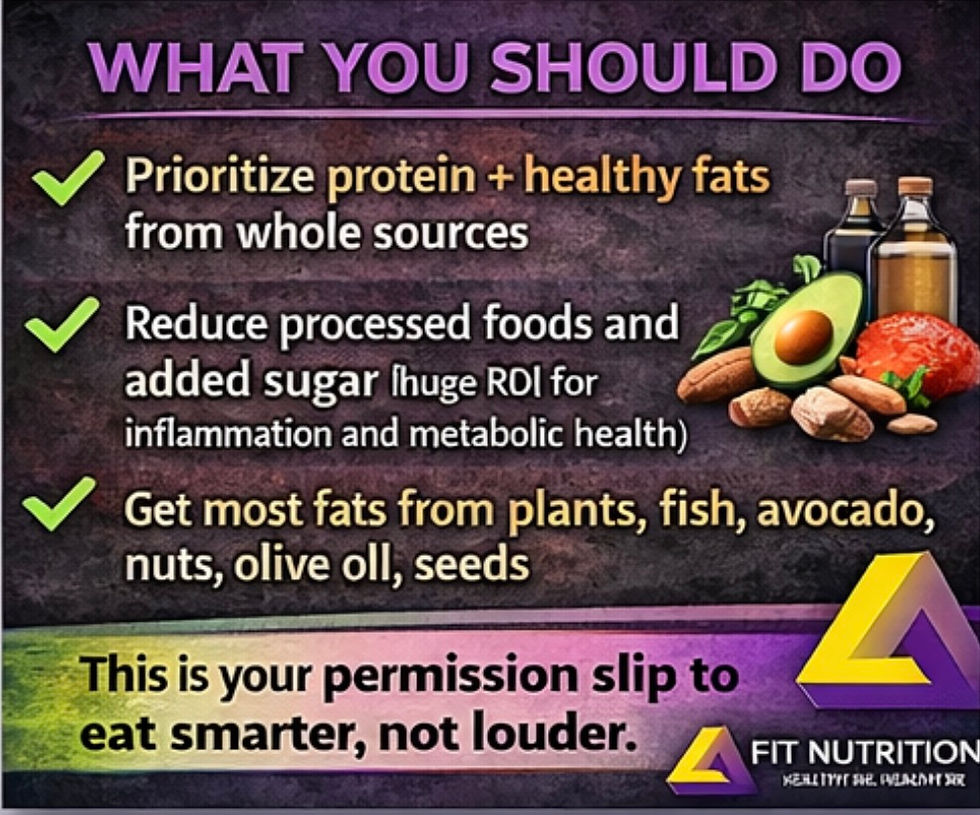
What can you do about it? Well, first of all, remember there's a difference between knowledge and prioritizing for you, and noise. The signals of knowledge to improve your nutrition are:
Prioritize protein and healthy fats
Reduce processed food and added sugar (don't eliminate them)
Get most fats from plant sources
And remember...
Processed Isn’t a Dirty Word — It’s a Spectrum.
Every food we consume has undergone some level of processing — even chopping, blending, heating, or cooking changes the structure of a food. A roasted sweet potato is technically more “processed” than a raw one. Protein powder is more processed than chicken breast. And sourdough bread is more processed than wheat berries.
The goal isn’t to avoid processing entirely — it’s to understand the degree, the intent, and the trade-off.
⸻
Performance Requires Simple Carbs — Especially for Athletes
For athletes, or anyone who trains like one (lifting heavy, sprinting, swimming, soccer, cycling — the work you coach), simple carbohydrates are not optional. They are: • The fastest way to replenish glycogen • A catalyst for protein uptake post-training • A key driver of mTOR activation (muscle-building pathway) • The difference between building muscle vs. burning out during a session
Breads, rice, honey, fruit jams, and even strategic simple sugars absolutely have a place in a performance nutrition plan. Muscle cannot be built efficiently in a low-glycogen state.
⸻
The Danger of “Eating Clean” Without Context
“Clean eating” culture has conditioned people to believe that:
• If a food comes in a package, it’s bad
• If sugar exists, it must be avoided
• If carbs are simple, they are the enemy
This is not science. This is extremism.
And I have been guilty of this mindset in the past, too.
Eating exclusively “clean” can lead to:
• Low energy availability
• Loss of lean mass
• Hormone disruption
• Poor training output
• Increased injury risk
• Higher stress and inflammation due to underfueling
For athletes, this mindset is especially damaging. It’s not clean eating — it’s underfueling in disguise.
⸻
Balance + Intention = The Intervention
Here’s the real framework:
Ask yourself:
• Is this food supporting my goal?
• Is it fueling my training or recovery?
• Is it replacing something worse, or adding something better?
• Is it intentional, or habitual?
Processed foods can be tools:
• Frozen fruit = processed, but excellent for smoothies and recovery
• Greek yogurt cups = processed, but high-protein and functional
• Whole grain bread = processed, but a strategic glycogen + energy source (athletes NEED THIS!)
• Beef jerky = processed, but portable protein for travel and training days
• Homemade muffins = processed, but better than gas station pastries
The problem is not processing. The problem is lack of intention, nutrient absence, and metabolic hijacking by additives and excess sugar.
Food isn’t good or bad. It’s either:
Supporting the work you’re doing, or
Working against it.
⸻
CONCLUSION:
Processed foods have a seat at the table. Ultra-processed foods shouldn’t own the menu. For performance-minded athletes — and the people who train like them — carbs, breads, and even simple sugars are strategic, functional, and sometimes essential.
The real target isn’t “processed.” It’s mindless consumption of nutrient-void foods.
The key is balance, intention, and metabolic purpose.
If you have more questions about nutrition, health, performance, and how to implement better habits, that's what I'm here for. Because a healthy ME = a healthy WE.
Much love,
AC